
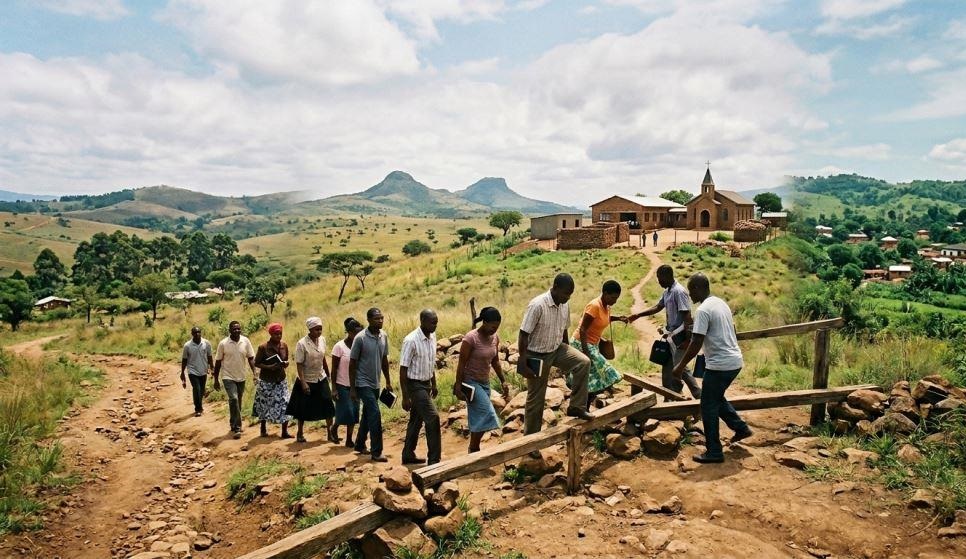
One of the greatest challenges I encountered in building sustainable discipleship models across different cultural contexts was the constant tension between meeting immediate physical needs and fostering long-term spiritual formation. In many of the communities where I served as a missionary — particularly in parts of the Kingdom of Eswatini, South Africa, and Nigeria — poverty was not an abstract issue; it shaped daily life in profound ways. Many individuals and families struggled with unemployment, food insecurity, inadequate healthcare, unstable housing, and limited access to education.
In such environments, discipleship could not be approached solely through Bible studies, church programs, or theological instruction. People were often carrying urgent burdens that demanded immediate attention. Parents worried about feeding their children, students could not afford school fees, and some families lacked access to basic medical care. These realities inevitably influenced how people engaged with ministry and spiritual formation.
One significant difficulty was that our ministry itself operated with limited financial resources. While we desired to support communities holistically, there were many moments when the needs around us exceeded our capacity to respond adequately. This created a tension that many missionaries and ministry leaders face: how do you encourage long-term spiritual growth when people are struggling simply to survive? At times, the inability to consistently meet practical needs affected trust, continuity, and the depth of discipleship relationships we hoped to cultivate.
Over time, these experiences challenged some of my earlier assumptions about ministry. I came to realize that sustainable discipleship cannot simply be imported as a fixed program or model from another cultural context. What works in one setting may not translate effectively into another. True discipleship must grow organically within the local culture, shaped by the language, values, struggles, and strengths of the people themselves. Sustainable ministry is not built primarily on outside structures, but on local ownership and participation.
This realization highlighted the importance of developing and empowering local leaders. Local believers understand the nuances of their communities far better than any outsider can. They possess cultural insight, relational credibility, and long-term presence that are essential for discipleship to continue beyond the involvement of external missionaries or funding sources. I learned that one of the most effective investments in ministry is not merely expanding programs, but equipping local men and women to lead, teach, mentor, and serve within their own communities.
Another important lesson was that discipleship becomes far more sustainable when it integrates spiritual formation with practical empowerment. In many communities, spiritual growth and daily survival cannot be separated. Ministry became more meaningful when it addressed both the soul and the social realities people faced. This included encouraging education, supporting skills development, strengthening families, promoting economic resilience, and fostering community support systems alongside biblical teaching and prayer.
Rather than viewing practical assistance and spiritual discipleship as competing priorities, I began to see them as deeply interconnected. When people experience dignity, stability, and hope in tangible ways, they are often better positioned to grow spiritually and invest in others. Holistic discipleship recognizes that faith affects every dimension of life — spiritual, emotional, relational, and economic.
These missionary experiences profoundly reshaped my understanding of what sustainability in ministry truly means. Early in ministry, it is easy to measure success through visible numbers: attendance, conversions, events, or short-term outcomes. However, over time I learned that sustainable discipleship is often slower, quieter, and deeply relational. It is measured by the development of faithful local leaders, the building of trust over time, and the creation of ministry models that communities can continue even with minimal outside support.
Ultimately, sustainability is not about dependency on missionaries, organizations, or funding streams. It is about cultivating communities of believers who are spiritually rooted, locally empowered, and capable of discipling others within their own cultural and social realities. Those lessons continue to shape how I understand mission work, leadership, and discipleship today.